This page contains links to reference sites for the material used in the EnergyZE ‘Thinking of Buying an EV‘ talk.
General Information Sites
- Ku-ring-gai Council Net Zero site has lots of information covering all aspects of emissions reduction and sustainability.
- Australian Electric Vehicle Association volunteer-run, not-for-profit organisation dedicated to switching Australia’s transport networks to electric as quickly as possible.
- Electric Vehicle Council peak national body representing the electric vehicle industry in Australia.
- TheDriven EV Focussed news site with model reviews and month by month Australian sales data by model.
- Rewiring Australia has a lot of useful information about EVs. Here is their FAQ and their very nice cost benefit calculator.
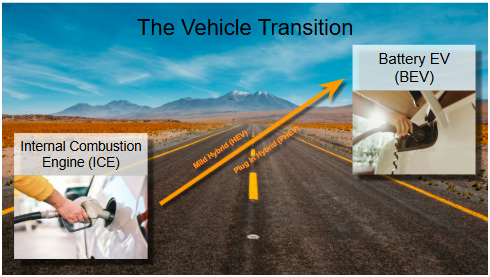
- Australian government site discussing transport emissions.
- Reduced numbers of ICE vehicles in areas of high EV adoption in California has been correlated to significantly reduced asthma related hospital admissions.
- Also here from the European Environment Agency and the National Library of Medicine.
- In 2024 Asthma Australia and the Centre for Safe Air made a joint submission to the Australian Government.
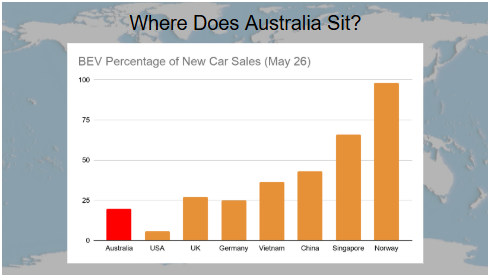
- Our World in Data has a lot of statistics at the country level tracking the transition from ICE vehicles to BEVs.
- Another look at world EV data from the International Energy Association.
- Australian Electric Vehicle Council report State of Electric Vehicles 2025.
- TheDriven news site has regular updates on EV sales by model in Australia.
- AEVA has fact sheets in a consistent form on most EV models available in Australia.
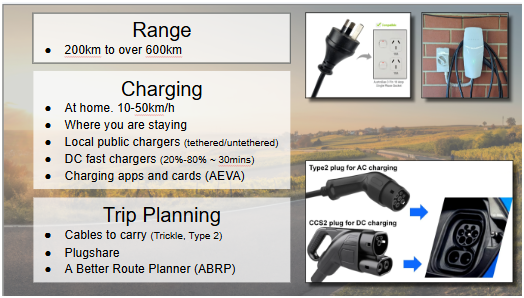
- Home charging options video by Solar Quotes
- Lithium Iron Phosphate (LFP) vs Nickel Cobalt Manganese (NCM) EV Batteries
- Ku-ring-gai Council Local Charging Map.
- PlugShare is a free app with Australia wide charging maps (actually most of the world). Shows whether charger has available plugs, power ratings and costs and comments from recent users.
- Another free app, A Better Route Planner has similar features to Plugshare but goes further allowing you to plan long distance trips with charging stops which take account of your vehicle’s range and road conditions.
- Instead of using all the different network apps to start a charging session you could join AEVA and invest $8 in an AEVA RFID card. Also allows you to start a charge if you phone has no signal. Currently works for: AGL; BP Pulse; Chargefox; Evie Networks; EVX; Exploren; Everty; Solarhub; Wevolt.
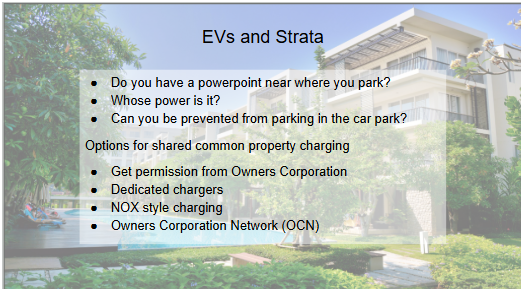
- Willoughby Council webinar about cost effective EV charging in Strata using a company called NOX
- Another similar system for strata charging.
- Owners Corporation Network (OCN) has lots of information about EVs in strata but some of it requires membership.
- NSW government position on EV charging in strata.
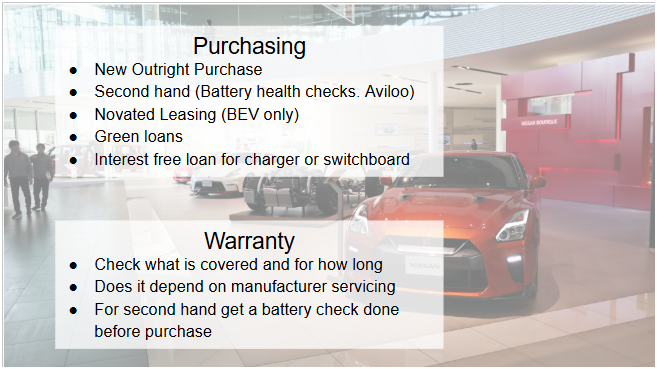
- Novated leasing is a tax effective way for some tax payers to reduce the cost of an EV.
- NRMA EV battery health check.
- Home Energy Saver interest free loans from the NSW State government.
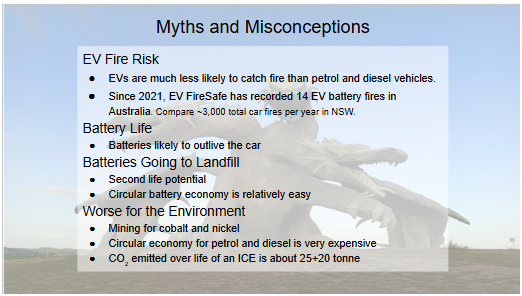
- EVs have a significantly lower fire risk than ICE or hybrid vehicles. The Australian Government resource Electric Vehicle Facts (EVF) has a good discussion of fire risk.
- While fires are very uncommon in EVs they are serious and require specialised fire fighting techniques. Australia leads the world in this. EVFireSafe is an Australian organisation funded by the Australian Department of Defense which records and reports on every fire related to an EV (in the world) and advises first responders. EVFireSafe’s information is technical and is intended to inform first responders but also act as an official source of data on fires. This is their key findings page.
- EV batteries are proving to have a long life, likely longer than the rest of the car. After use in a vehicle man will have a second life before being recycled. Read more from the NRMA or the Electric Vehicle Council. Here is a news report of a West Australian company who is establishing an EV battery recycling facility.
- The question of whether EVs are more environmentally friendly than ICE vehicles has been settled for a long while. Read here from the Electric Vehicle Council or here from the Australian Government.
- The ABC has put together a very nice comparison of lifecycle carbon footprint of EVs vs ICE. More can be found here from the Australian government and here from a big European analysis.
- The most common type of EV battery now is Lithium Ion Phosphate (LFP). This eliminates the issues around mining for cobolt and nickel which are used in Nickel Cobolt Manganese (NCM) batteries. Here from Sydney University and Climate Home News.
- These and other myths are discussed in this UK publication adapted by the Australian Electric Vehicle Association (AEVA) called The Little Book of EV Myths